25 Years of IMPACK:
From a Garage-Built Idea to a Global Engineering Company
Twenty-five years ago, IMPACK began with a problem, an idea and a young engineering student who could not stop thinking about how to solve it.
From those small beginnings, the company has grown into a company that designs and manufactures automation machines for packaging producers around the world. Yet behind the machines much of the spark of those earliest days remains remarkably familiar.
It started with a problem
Before there was IMPACK, there was Dominic Thériault's instinct to create.
Growing up, Dominic was naturally curious about how things worked. He remembers spending hours with his brother building projects with Legos. Later, while studying engineering and completing internships in the packaging industry, that curiosity found a practical outlet. He began noticing processes that could be improved—and imagining machines that might improve them.
While still at university, Dominic was working as a consultant for a folding carton packaging company struggling with challenges in packing boxes. He started sketching concepts for packing machines—even during his university classes.
Then, the idea that would eventually lead to IMPACK arrived in a flash.
“I was driving my car on the highway when I had the flash of a first machine concept. I had to pull over to draw it quickly. I didn’t want to forget it!”
— Dominic Thériault, President and Founder
Dominic patented the concept and proposed it to the client. That first version worked in production for several years.
The experience revealed an opportunity much larger than a single machine. Packing at the end of folder-gluer lines was an area where significant manual work remained—and where better automation could make a difference. That same challenge remains at the heart of IMPACK's work today.
Innovation in it's earliest form: Dominic working through the challenges, convinced the idea would work.
Building machines with whatever was available
The beginnings were humble in every sense.
The project received support from the Centre d’entrepreneurship de l’ÉTS in Montreal (CENTECH), but the actual work began at Dominic's home in Saint-Jacques and in his cousin Bruno Mercure’s garage.
There was no sophisticated manufacturing equipment. Dominic and his cousin built concepts with pieces of wood. Drills were used as motors.
After a first round of financing, the young company moved into a former tractor repair garage in 2002 and adapted the space itself. Even the most basic amenities were limited: their section of the building had no washroom, so they had to use an unheated one next door.
The limitations were significant, but so was the determination.
Looking at a photograph from those early years, Dominic remembers not only the excitement, but the pressure behind it.
“We hadn’t sold anything yet. We were only developing. Establishing a new company and the cost of R&D was putting me in debt. The machine had to work.”
His approach to engineering was equally persistent: he believed that somewhere, a solution existed; it simply had to be found. There were nights spent alone in the shop working through a problem until the answer finally came.
“Sometimes I spent the whole night at the shop. One time, I found the solution at 5 a.m.”
A student club that became a company
Dominic brought together a group of his fellow engineering students, including Mathieu Tremblay and Michel Beauséjour, who would go on to play important roles in IMPACK's history.
Mathieu Tremblay, now Managing Director, remembers those early years with affection.
“The first years felt more like a student club than a company. We didn't know what we were doing, but we did it with passion and determination!”
— Mathieu Tremblay
There was truth behind the joke.
The team had to start from scratch: find suppliers, choose components, design machines, prepare electrical plans, write programs, identify applicable standards and understand how to meet them.
“We learned everything as we went,” Mathieu recalls.
What they lacked in experience, they compensated for with curiosity and a willingness to experiment.
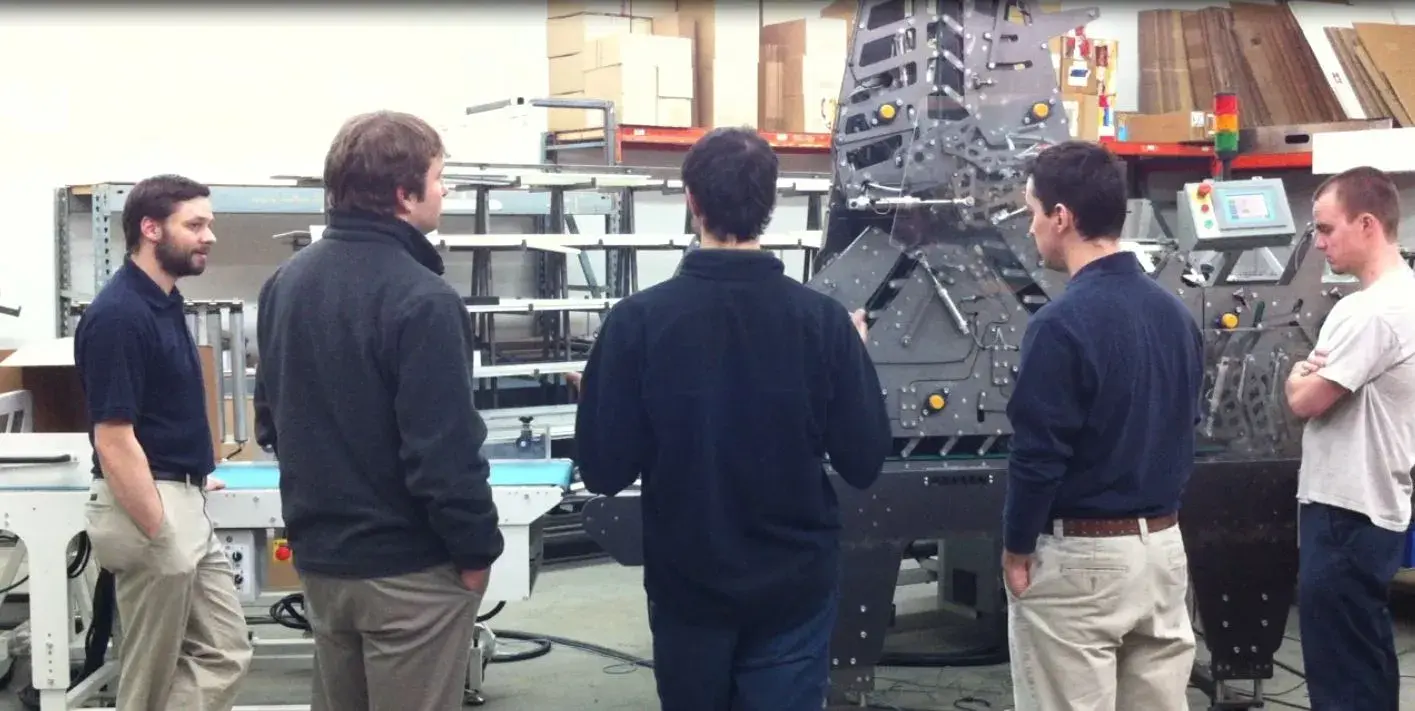
Dominic remembers the small group gathering around machines, discussing what could be changed and improved. They did not have the resources to pursue every idea, so they had to choose which concepts to develop and commercialize to finance the next ones.
That period produced the foundations of IMPACK's early product portfolio, including the VIRTUO automatic packer, ERGOSA semi-automatic packer and MFA batch inverter.
Learning alongside customers
One of the defining characteristics of those early years was that development rarely happened in isolation.
“We were a small team and we had the right to dream,” Dominic recalls.
When someone had an idea with potential, the approach was straightforward: build a prototype and see what happened.
Many of those prototypes were developed with customers willing to test them in real production environments. That collaboration created a cycle: IMPACK would develop a solution, customers would test it, and their experience would reveal the next problem worth solving.
As these relationships strengthened, the exchange began to work both ways. Customers came to see IMPACK as more than an equipment supplier. They saw a team of engineers willing to tackle their production challenges. Some began bringing their own problems directly to IMPACK, trusting the team to explore possibilities and develop solutions where none existed. This close collaboration and that willingness to try became part of IMPACK's culture.
It was not about knowing in advance that every idea would succeed. It was about creating an environment where an idea could be explored before being dismissed.
“The company was created to realize the ideas that we had in our minds. We just wanted to create.” — Dominic Thériault
Taking the first steps beyond Quebec
By 2005, IMPACK was ready to look beyond its home market. The company began developing the U.S. market, opening what Dominic says is still an important market for IMPACK.
Then came Europe, where IMPACK installed the first machine in 2008.
Growth was gaining momentum; until the global financial crisis changed everything.
Revenue dropped sharply, and IMPACK faced one of the most difficult periods in its history. Rather than resorting to layoffs, the company made a deliberate effort to retain its core team, navigating the crisis project by project with support from government programs.
It was an early reflection of a value that continues to define IMPACK today: putting people first. Protecting the team meant preserving not only jobs, but also the knowledge, talent and collaborative spirit that would be essential to the company's future growth.
This period ultimately helped set the stage for one of the company's most important turning points.
From start-up to the global stage
In 2012, IMPACK entered into an international agency partnership with a leading global folder-gluer manufacturer.
For Mathieu, that partnership marked a clear dividing line in IMPACK's history.
“This agency agreement in 2012 was decisive. It put us on the map and brought us into the big leagues.” — Mathieu Tremblay
The partnership gave IMPACK access to a global sales network and greater exposure to packaging producers around the world. It also brought invaluable market feedback that pushed the team to continually refine its technology.
The same year, 2012, marked another symbolic milestone: IMPACK exhibited at Drupa for the first time.
Four years later, at Drupa 2016, Dominic remembers realizing that something fundamental had changed.
“In 2016, I wrote to my daughter: ‘We made it.’ Everybody was talking to us and everybody wanted to do business with us.”
The little engineering project had become a company with a place in the global packaging industry.
Growing without losing the spark
Growth brought a different challenge: how do you turn a small start-up into a structured organization without stifling the creativity that characterized it?
For IMPACK, innovation remained the center around which the rest of the company grew.
As Mathieu puts it:
“Without innovation, IMPACK would still be a very nice company. But it would no longer be IMPACK.”
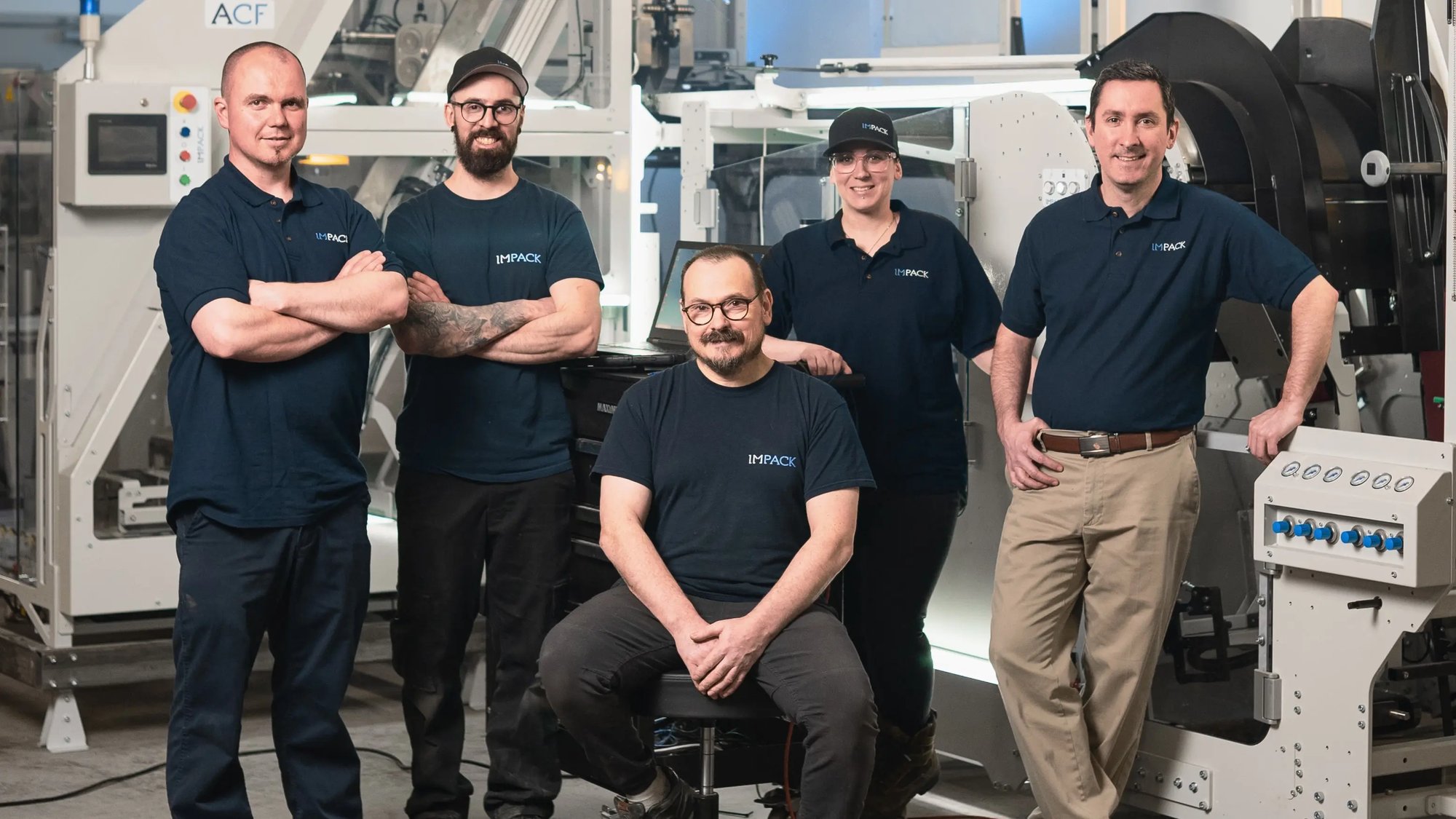
The scale is different today. Engineering, manufacturing, sales, marketing, administration and service all have defined roles. Dedicated teams can work on production while others concentrate on R&D. This was impossible when the same handful of people had to develop, manufacture, commercialize and install the machines themselves.
But Engineering Director David Leblanc still recognizes the early IMPACK in the way his team works today:
“IMPACK has grown considerably over the years, but the spirit of our early days remains. Everyone is encouraged to share ideas, challenge the way things are done and contribute to improving our machines. That desire to innovate, experiment and find better ways of doing things is what continues to drive us.”— David Leblanc
That culture now extends well beyond engineering. IMPACK describes its team as people who care, challenge each other, and grow together.
Their curiosity and collaboration continue to shape how the company approaches its work.
From a handful of students to a company
owned by its people
Since 2005, IMPACK has embraced a cooperative business model, giving employees the opportunity to become shareholders and share in the company's success. Unlike traditional ownership structures, a cooperative emphasizes collective participation, shared responsibility and long-term prosperity.
This approach reflects IMPACK's belief that the people who contribute to building the company should also benefit from its growth. Today, this philosophy remains central to it's culture, fostering a sense of ownership, collaboration and commitment to the company's future.
Leadership has evolved as well. Mathieu Tremblay, who joined IMPACK as an electrical engineering and automation intern in 2003 when the company had only five employees, became Managing Director in 2025. Dominic moved toward a strategic role as President, focused on the company's stability and future development.
Perhaps the clearest measure of how IMPACK has changed over 25 years is the answer Dominic now gives when asked what makes him proudest.
“At first we were proud of our innovations, our patents. Then we were proud of the number of machines sold and the number of countries where we had installed them. But today, it’s the team we’re most proud of.” — Dominic Thériault
It is a remarkable progression for one of the young engineers who once stood beside those early prototypes trying to figure things out as they went.
Still building
Twenty-five years after those first experiments in a garage, IMPACK is once again surrounded by construction.
In June 2026, work began on a new facility adjacent to the company's Saint-Jacques headquarters. The expansion will add six assembly workstations, a dedicated shipping dock, modern office space and centralized parts storage. The existing facilities will then provide additional space for engineering, machine commissioning and new product development.
The surroundings may be very different from the former tractor garage of 2002.
The motivation behind them is not.
Today, more than 1,000 machines have been installed across 29 countries. There are still machines to improve. Problems nobody has solved quite well enough. Ideas waiting to be tested. And a team willing to ask, ‘What if we tried this?’
Dominic hopes that remains true long after the company's 25th anniversary.
“The company was founded to realize the ideas we had in our heads. It is first and foremost a place of creation, collaboration and fulfillment.”
Looking back, those words may be the simplest way to tell IMPACK's story.
The company began without a factory, without much equipment and without certainty that its ideas would work. What it did have was a small group of people willing to create, experiment, learn and keep going.
Twenty-five years later, the scale has changed.
The impulse to create has not.